

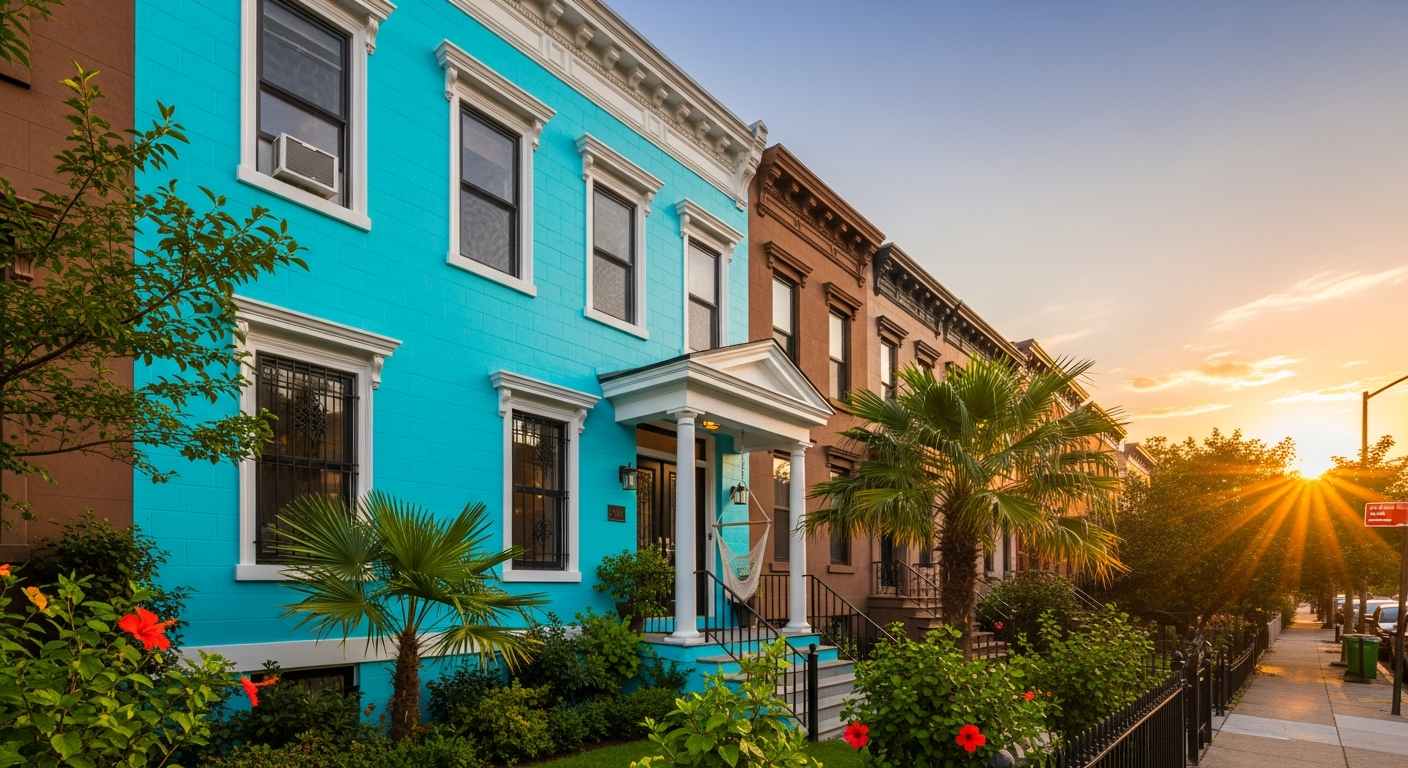
Why Brooklyn is a top choice for Caribbean Homebuyers
Brooklyn is home to one of the largest Caribbean communities outside the islands themselves — more than 250,000 residents of Caribbean descent, anchored in Flatbush, East Flatbush, Canarsie, Crown Heights, East New York, and Brownsville. For first- and second-generation Caribbean-American buyers, the borough offers something rare in New York City: intact cultural infrastructure, deep family networks, and a housing stock (especially 2-to-4-family row houses) that rewards the multigenerational, rental-income-minded approach many Caribbean families already live by. This guide walks through the neighborhoods, property types, financing programs (FHA, SONYMA Achieving the Dream, HomeFirst), closing costs, inspection issues, and cultural anchors that matter when buying a home here.
Why Brooklyn Is a Uniquely Strong Market for Caribbean-American Buyers
Walk down Church Avenue on a Saturday morning and you will hear more patois, Kreyol, and Trinidadian English than you will in most places outside of Kingston, Port-au-Prince, or Port of Spain. That is not an accident. Caribbean migration to Brooklyn began in significant numbers in the 1960s after the Hart-Celler Act, deepened through the 1980s and 1990s, and has produced a community large enough to sustain its own churches, bakeries, doctors’ offices, accountants, real estate agents, funeral homes, and remittance services. In Community District 14 (Flatbush/Midwood) and District 17 (East Flatbush), the foreign-born Caribbean population is among the highest in the United States.
For a buyer, that density matters in concrete ways. It means a West Indian bakery, a Seventh-day Adventist church, a doctor who takes your parents’ insurance, and a hardware store run by someone from back home are all within a ten-minute walk. It also means the housing stock was built, over a century of New York City growth, in formats that happen to fit the way many Caribbean families actually live: multigenerational, with rental income built into the structure of the home.
The Core Neighborhoods
Flatbush and East Flatbush
This is the heart of Brooklyn’s Caribbean community. Flatbush proper — running roughly from Prospect Park south along Flatbush and Church Avenues — and East Flatbush, east of Nostrand, together form the largest concentration of Haitian, Jamaican, Trinidadian, Guyanese, and Grenadian residents in the city. The housing is primarily 1920s-1940s brick row houses and semi-detached two-families, with some freestanding Victorians on the north end near Prospect Park South.
Typical pricing as of early 2026: single-family row houses run roughly $750,000 to $1.1 million; 2-family brick homes $900,000 to $1.4 million; 3-family homes $1.1 million to $1.6 million. Larger Victorians in Prospect Park South and Ditmas Park command $2 million plus. The commercial corridors — Flatbush Avenue, Church Avenue, Nostrand Avenue, and Utica Avenue — are lined with Caribbean groceries, roti shops, bakeries, and the bus routes (B41, B44, B46) that connect everything.
Canarsie
Canarsie is the quieter, more suburban-feeling choice and is heavily Caribbean — particularly Jamaican and Haitian. The housing stock is distinctive: long blocks of attached brick row homes built in the 1940s and 1950s, most with private driveways, small front lawns, and finished basements. You will see this pattern especially south of Flatlands Avenue and into the Seaview and Bayview sections.
Pricing typically runs $700,000 to $950,000 for a single-family attached row home and $950,000 to $1.3 million for a legal two-family. Canarsie does not have a subway; it is served by the L train terminus at Canarsie-Rockaway Parkway and an express bus network into Manhattan. Buyers who want a driveway, a backyard, and a quieter block at a lower per-square-foot price than Flatbush tend to land here.
Crown Heights (Parts)
Crown Heights east of Utica, and the blocks along Empire Boulevard and around Kings County Hospital, have long-established Caribbean roots, including the route of the West Indian American Day Parade on Eastern Parkway. Western Crown Heights has gentrified significantly and prices have followed — expect $1.4 million to $2.5 million for brownstones west of Nostrand. East of Utica, 2-family brick homes still trade in the $1.1 million to $1.5 million range.
East New York and Brownsville
For buyers priced out of Flatbush, these neighborhoods offer the most attainable entry into Brooklyn homeownership. East New York has pockets of 1- and 2-family frame and brick homes in the $550,000 to $850,000 range. Brownsville is similar, with additional opportunities through NYC HPD’s affordable homeownership programs. Both neighborhoods are part of the East New York rezoning area, which has brought new construction and, eventually, new amenities, though transit is slower and retail is still thinner than in Flatbush.
Why 2-to-4-Family Homes Are the Strategic Play
This is the single most important point in this guide. A huge share of Brooklyn’s Caribbean housing stock consists of legal 2-family, 3-family, and 4-family homes. For buyers, these properties are strategic for four reasons:
1. Rental income offsets the mortgage. A legal 2-family in East Flatbush renting the second unit at $2,400 a month generates roughly $28,800 a year toward the mortgage. On a $1.1 million purchase with 3.5% down via FHA, that rent covers a meaningful portion of the monthly PITI.
2. Multigenerational living is built in. Parents on the garden floor, the buyer’s family on the parlor and second floors, a sibling or adult child on the top. This is how many Caribbean families already organize themselves, and the housing stock was literally built for it.
3. FHA allows 3.5% down on owner-occupied 2-to-4-family. If you live in one unit as your primary residence, FHA will finance a 2-, 3-, or 4-family property with only 3.5% down (on loans up to the FHA limit, currently $1,209,750 in Brooklyn for 2-unit and higher for 3- and 4-unit). This is the “house hack” model, and it is the single most accessible path into Brooklyn ownership for buyers without family wealth to draw on.
4. Rental income helps you qualify. FHA will count 75% of the projected market rent from the non-owner-occupied units toward your qualifying income. This is how buyers with moderate incomes still qualify for $1M-plus properties.
Important: the property must be a legal 2-, 3-, or 4-family per the NYC Department of Buildings certificate of occupancy. Many Brooklyn homes have an unofficial basement or attic unit that is not legal. Your real estate attorney and inspector must verify the CofO before you close — this is not optional.
Financing: The Programs That Actually Help
FHA (3.5% Down)
The Federal Housing Administration loan, insured by HUD, remains the workhorse program for this buyer segment. Key features: 3.5% minimum down payment, credit scores accepted as low as 580 (sometimes 620 with lender overlays), owner-occupancy required for at least one unit, mortgage insurance for the life of the loan unless you refinance out later. 2-, 3-, and 4-family properties all qualify.
SONYMA Achieving the Dream
The State of New York Mortgage Agency’s Achieving the Dream program is specifically aimed at low-to-moderate income first-time buyers. Interest rates are typically below market, down payments can be as low as 3%, and it can be combined with SONYMA’s Down Payment Assistance Loan (up to $15,000 or 3% of the purchase price, whichever is greater) as a forgivable second mortgage. Income limits apply and vary by household size and county.
HomeFirst Down Payment Assistance
NYC HPD’s HomeFirst program provides up to $100,000 in down payment or closing cost assistance for first-time buyers purchasing a 1-to-4-family home, condo, or co-op in one of the five boroughs. It is a forgivable loan, provided you remain in the home for 10 to 15 years. Buyers must complete a HUD-approved homebuyer education course and meet income limits (generally up to 80% of Area Median Income, though the program has expanded AMI tiers).
Banks and Credit Unions That Know the Community
Several institutions have long histories lending in Brooklyn’s Caribbean neighborhoods and are often more flexible on documentation (for example, self-employed buyers, cash-intensive business owners, or buyers with international credit histories). Ask me for a current list; commonly named lenders include Municipal Credit Union, Popular Bank, Carver Federal Savings Bank, and TD Bank’s CRA-eligible programs. For buyers with nontraditional credit, a community development financial institution (CDFI) loan officer can sometimes structure a file that a big bank cannot.
Cultural Anchors That Should Shape Your Search
When you filter listings, filter by more than price and square footage.
- Markets and corridors. The Flatbush Avenue and Church Avenue corridor is the commercial spine. Nostrand Avenue between Empire Boulevard and Avenue H is another. Utica Avenue runs the length of the Caribbean belt.
- West Indian Carnival and Labor Day Parade. Eastern Parkway between Utica and Grand Army Plaza is the parade route. If you are a mas player, a band member, or simply someone who hosts family that weekend, proximity matters.
- Schools. The NYC DOE’s District 17 and District 22 schools have long-established Caribbean-American teacher and administrator pipelines. If continuity of cultural identity in the classroom matters to you, research individual schools through the DOE’s School Quality Reports.
Buying Tips and Inspection Red Flags
Brooklyn’s housing stock is old. Most of the row houses you will tour were built between 1900 and 1940. Every inspection should explicitly check:
- Knob-and-tube or cloth-wrapped electrical wiring. Common in houses built before 1950, sometimes not fully replaced even after renovations.
- Cast iron and galvanized plumbing. Replacements to copper or PEX are a significant expense if not already done.
- Oil-to-gas conversion status. Many Brooklyn homes still have oil tanks or recently converted from oil. If the tank was buried in the yard, you want documentation of proper abandonment or removal.
- Roof age and parapet walls. Flat roofs on row houses typically last 15-20 years; parapet wall repairs can run five figures.
- Basement dampness and drainage. Especially important for the garden-floor rental unit.
- Certificate of Occupancy matches use. Critical for 2-4 family properties.
- Open DOB and ECB violations. Run the address on the NYC DOB BIS and ECB systems before you sign a contract. Open violations can block a closing and must be cured by the seller.
Co-op vs. Condo vs. Multifamily: Which Is Right?
- Multifamily (1-4 unit) home: Full ownership, rental income, no board approval. This is the dominant Caribbean-American buyer path for good reason.
- Condo: You own the unit and a share of common areas. No board approval beyond a right of first refusal in most cases. Better for single buyers or couples not interested in being landlords. Common in Downtown Brooklyn, newer construction along Flatbush and in Crown Heights.
- Co-op: You own shares in a corporation that owns the building. Cheaper per square foot than condos but requires board approval and often has strict financial requirements (2 years of reserves post-closing, limits on financing, interview process). Many older Brooklyn buildings are co-ops, including some in Flatbush. Board approval processes have, historically, been a friction point for buyers with nontraditional income documentation — go in with a strong, organized financial package.
NYC-Specific Closing Costs
Plan for total buyer closing costs of roughly 3% to 6% of the purchase price, more if the home is over $1 million.
- Mortgage recording tax: 1.8% on loans under $500,000, 1.925% on loans $500,000 and over. Paid by the buyer.
- Title insurance: Roughly 0.5% of the purchase price.
- Mansion tax (buyer pays): 1% on purchases from $1,000,000 to $1,999,999, scaling up to 3.9% on $25M+. This is the single largest closing-cost surprise for first-time Brooklyn buyers crossing the $1M threshold.
- NYC and NYS transfer taxes (typically seller-paid): 1.4% combined for properties under $500,000, 1.825% for $500,000+. In a seller’s market, buyers are sometimes asked to absorb these — push back.
- Attorney fees: $2,500-$4,500 for a straightforward Brooklyn transaction. Use a real estate attorney who closes regularly in Brooklyn; this is not the place to save money.
- Buyer’s home inspection: $600-$1,200 for a 2-4 family.
Frequently Asked Questions
Can I really buy a $1.1M two-family in East Flatbush with $40,000 down?
With an FHA loan and the property qualifying, yes — 3.5% of $1.1M is $38,500. You will also need closing costs and reserves. HomeFirst and SONYMA assistance can cover a meaningful portion of the down payment and closing costs if you qualify.
My parents want to help with the down payment. Does that cause problems with the lender?
No. Gift funds from immediate family are allowed on FHA and conventional loans. The lender will require a gift letter and proof of transfer. Do not move money in and out of your account in the 60 days before application without documentation — lenders will ask.
I am self-employed / paid partially in cash. Can I still qualify?
You will need two years of tax returns showing the income you want the lender to count. Community-focused lenders and CDFIs can sometimes work with 12 months of bank statements instead, at slightly higher rates.
What if the basement apartment is not on the Certificate of Occupancy?
You cannot count that rent toward qualifying income, you cannot legally rent it after closing, and the lender may not approve the loan if the appraiser flags the unauthorized unit. Either negotiate the price down to reflect a true 2-family (when listed as 3) or walk away.
How competitive is the market right now in Flatbush and Canarsie?
Well-priced 2-families in Flatbush, East Flatbush, and Canarsie continue to see multiple offers, typically closing within 2-4% of asking. Overpriced listings sit. A strong agent will tell you honestly which is which.
Are there first-time homebuyer classes specific to this community?
Yes. Neighborhood Housing Services of Brooklyn, the Center for NYC Neighborhoods, and several Caribbean-American community organizations run HUD-approved homebuyer education courses — often a requirement for HomeFirst and SONYMA. Many are offered in Haitian Kreyol as well as English.
What is the timeline from offer to closing?
With FHA financing, plan for 60-75 days from accepted offer to closing. Cash deals can close in 30-45. Co-ops add 30-60 days for board package review.
Should I buy now or wait?
Brooklyn prices in Caribbean-anchored neighborhoods have appreciated steadily through every cycle since the 1990s, driven by limited supply and strong community demand. “Waiting” typically means paying more later. The right question is not timing the market — it is whether your financing, reserves, and chosen block are right.
Next Steps
Buying in Brooklyn is specific, document-heavy, and high-stakes — and for a Caribbean-American buyer it is also deeply personal, because the home you choose tends to anchor your family for a generation or more. We work with first- and second-generation buyers across Flatbush, East Flatbush, Canarsie, Crown Heights, and throughout central and southern Brooklyn every week. We will walk you through pre-approval, connect you with lenders who understand the community, tour the neighborhoods that fit your family, and negotiate the closing on your behalf.
Reach out to Maxine McClinton with Own A Piece of Brooklyn to start the conversation. Whether you are six months out or ready to write an offer next week, the first call is always free.