
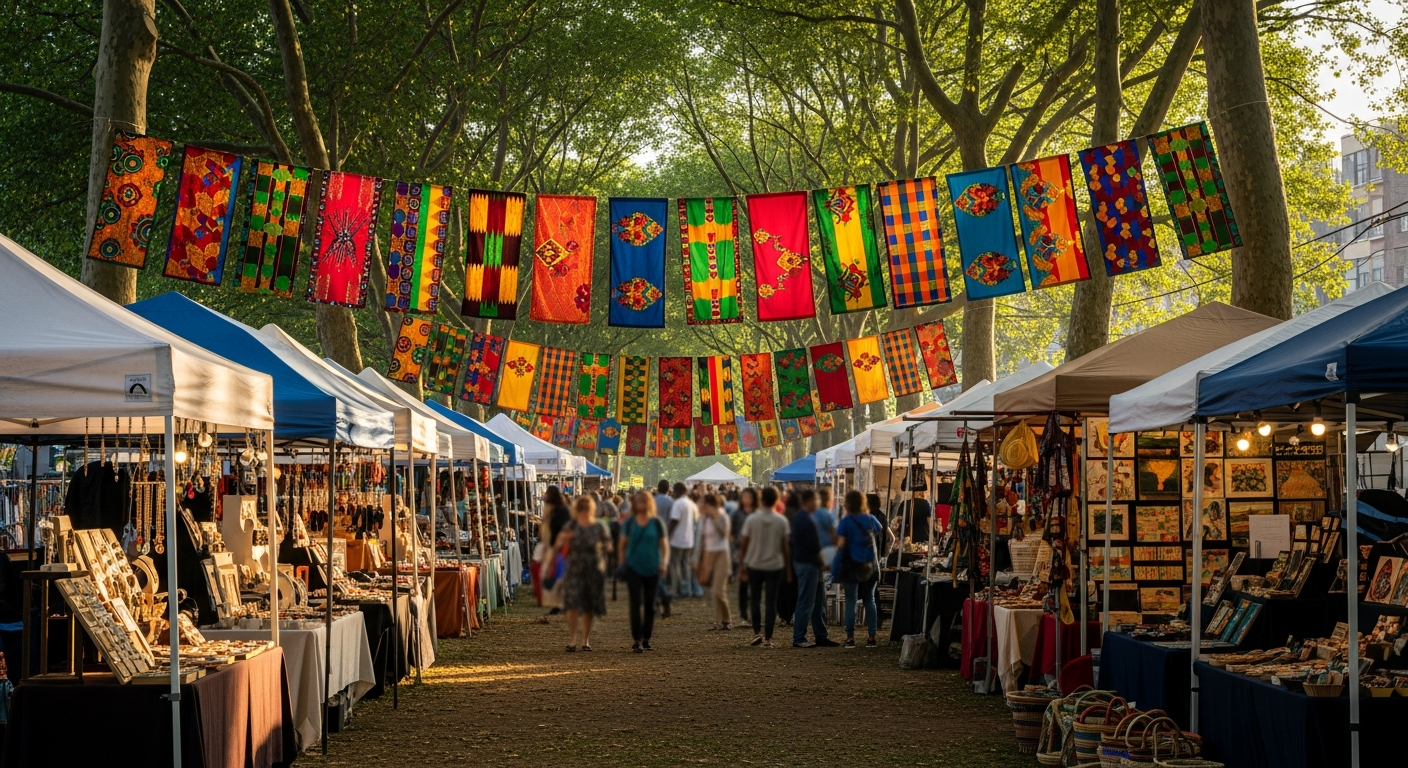

The International African Arts Festival — Brooklyn's longest-running celebration of African, Caribbean, and African American arts and culture — returns for its 55th edition over the Fourth of July weekend, July 3-5, 2026. For 2026, the festival relocates to Lincoln Terrace Park at 299 Buffalo Avenue in Crown Heights, a meaningful shift after years anchored at Commodore Barry Park in Fort Greene. Organized by the nonprofit International African Arts Festival, Inc., the three-day gathering brings together a global marketplace, live music and dance, food from across the diaspora, a children's village, and a community of vendors and artists that traces its roots back to a single block party in Bedford-Stuyvesant in 1971.
If you live in Crown Heights, Bed-Stuy, Flatbush, or anywhere across central Brooklyn, this is the weekend the neighborhood opens up. Save the dates, share them with family, and read on for what's confirmed, what's tradition, and how to plan your visit.
A 55-year arc: from a Bed-Stuy street carnival to an international institution
The festival's origin story is unusually well-documented for an event of its scale. In 1971, a group of educators and parents associated with the Uhuru Sasa Shule, an independent Pan-African school then operating in Bed-Stuy, organized what they called the "African Street Carnival" on Claver Place. The idea was straightforward — give children, families, and neighbors a place to celebrate African heritage on Brooklyn ground, with vendors, music, and food they recognized. That first carnival drew a few hundred people. By the late 1970s it had outgrown its block and moved to Boys and Girls High School. By the 1980s it had a new name — the International African Arts Festival — and a new home at Commodore Barry Park near the Brooklyn Navy Yard, where it remained as its anchor venue for decades.
What distinguishes the IAAF from other diaspora festivals isn't just longevity, although 55 consecutive years is rare for any community-organized event in New York City. It's the breadth. The West Indian American Day Carnival on Eastern Parkway is unmistakably Caribbean. AfroPunk leans avant-garde and youth-driven. DanceAfrica at BAM is curated and stage-focused. The International African Arts Festival pulls from all of those traditions at once — continental African, Caribbean, African American, Afro-Latin — and stages them as a single open-air gathering. You'll hear soca next to highlife next to gospel next to Afrobeats, often within an hour of each other.
The festival is run by International African Arts Festival, Inc., a 501(c)(3) nonprofit. Programming has historically been shaped by a small staff and a long roster of returning vendors, performers, and volunteer coordinators — many of whom have been part of the festival for decades.
What to expect in 2026: marketplace, mainstage, food, family
The 2026 lineup will roll out closer to the dates, but the festival's structure has remained consistent for years and is a useful guide to what to expect.
The Global Marketplace is the heart of the event. Expect well over 100 vendors selling textiles, jewelry, sculpture, beauty products, books, music, clothing from designers across the diaspora, and crafts sourced from West Africa, the Caribbean, and Black-owned New York businesses. For many vendors, the IAAF weekend is one of their largest sales periods of the year.
The Mainstage runs all three days with rotating performances — drum ensembles, dance companies, soca and reggae acts, gospel choirs, spoken-word artists, Afrobeats DJs, and headliners that change year to year. Past years have featured a mix of established touring artists and Brooklyn-based performers.
Food vendors typically range from Jamaican jerk and oxtail to Senegalese thieboudienne, Trinidadian doubles, Ethiopian platters, Nigerian jollof, and Southern soul-food staples. Vegetarian and vegan options are generally well-represented.
The Children's Village offers drumming circles, storytelling, face painting, and educational activities geared toward kids. It's typically set up in a quieter zone of the park.
The Opening Libation Ceremony is a separate ticketed event that traditionally precedes the main weekend. For 2026, the official opening libation is scheduled for Sunday, June 7, 2026, at The Billie Holiday Theatre in Bedford-Stuyvesant. Tickets are available through Eventbrite. The libation is a more formal, ceremonial gathering — pouring of libation, honoring of elders, and acknowledgment of those who have shaped the festival's history.
For the most current 2026 schedule, vendor list, and any updates, visit IAAFestival.org or follow @IAAFestival on social media.
Why this festival matters to Brooklyn
It's easy to write about the International African Arts Festival as an event. It's harder, and more accurate, to write about it as an institution.
For more than two generations, the IAAF has been a fixed point on Brooklyn's cultural calendar — the place where grandparents bring grandchildren they want to introduce to a piece of family heritage, where vendors return year after year to set up the same booth, where local performers get an early break and touring artists come through to remind New York they exist. Crown Heights, Bed-Stuy, and Fort Greene have shifted significantly over the past two decades. The festival has been one of the steady community anchors through that change.
When the IAAF takes over Lincoln Terrace Park this July, it brings with it a kind of cultural memory that doesn't show up on a real-estate listing but is unmistakable to anyone who lives in the surrounding blocks. The drum circles. The smell of jerk smoke. The kids running between booths with little flags from countries they may have never visited but feel a connection to. That's the texture of the neighborhood — not a marketing claim, just what's actually there.
The neighborhood angle: Crown Heights and the festival's new home
The 2026 venue change is notable. Lincoln Terrace Park is a large public park on the eastern edge of Crown Heights, bordering Brownsville, bisected by Buffalo Avenue. The park has been part of NYC's parks system since 1895, with major improvements added in the 1930s under the WPA. Hosting the IAAF here brings the festival deeper into the heart of central Brooklyn's residential neighborhoods — closer to the homes and brownstone blocks of Crown Heights proper, rather than the more commercial-industrial edge near the Navy Yard.
For homeowners and prospective buyers in Crown Heights, Bed-Stuy, and Flatbush, that proximity is part of what defines life in these neighborhoods. Living near the festival doesn't mean enduring three days of crowds — it means the cultural fabric of the neighborhood is genuinely present in your daily life. Independent businesses, community gardens, block associations, places of worship, and events like the IAAF are what make central Brooklyn what it is. Communities with active cultural institutions tend to retain their identity over time, and that identity is part of what people are buying into when they invest in a home in this part of the borough.
We've worked with families across Crown Heights, Bed-Stuy, and the surrounding neighborhoods who specifically wanted to be within walking distance of the cultural life that the festival represents — not because of a single weekend, but because that weekend is symptomatic of a larger pattern of community organizing, Black-owned business, and intergenerational rootedness.
Visitor logistics: how to get there, what to bring
Address: Lincoln Terrace Park, 299 Buffalo Avenue, Brooklyn, NY 11213.
By subway: The 3, 4, and 5 trains serve the area. The closest stops are Crown Heights-Utica Avenue (roughly a 12 to 15 minute walk via the 3 and 4) and Sutter Avenue-Rutland Road (about a 10 minute walk via the 3). From Manhattan, the 2/3 or 4/5 from Times Square, Grand Central, or Bowling Green will all get you there within 35-45 minutes depending on time of day. If you're coming from northern Brooklyn or Queens, the G train connects to the 3/4 transfer at points along the route.
By bus: The B12, B14, and B46 all run near the park. The B46 along Utica Avenue is often the most direct option from Bed-Stuy.
By car: Street parking around Lincoln Terrace Park is limited and gets tight during festival hours. If you must drive, arrive early or plan for a longer walk from available parking. Lincoln Terrace is not a destination set up for large parking lots — it's a neighborhood park.
What to bring: Sunscreen, a refillable water bottle, comfortable shoes, cash for vendors who may not take cards (most do these days, but bring some anyway), a tote bag if you plan to shop, and a folding chair or blanket if you want to settle in for the mainstage. Strollers are welcome. The park has restrooms but plan for lines.
Accessibility: Lincoln Terrace Park is largely flat with paved pathways. Specific accessibility accommodations should be confirmed through the festival organizers closer to the event.
Common questions
Is the International African Arts Festival free?
General admission to the festival weekend at Lincoln Terrace Park has historically been free or low-cost suggested donation. Some elements — the opening libation ceremony, specific VIP experiences — are ticketed separately through the festival's Eventbrite page. Confirm current admission details at IAAFestival.org.
What are the 2026 dates?
July 3-5, 2026 (Friday, Saturday, and Sunday). The Opening Libation Ceremony is held earlier, on June 7, 2026, at The Billie Holiday Theatre.
Where exactly is it held?
Lincoln Terrace / Arthur S. Somers Park, 299 Buffalo Avenue, Brooklyn, NY 11213, in Crown Heights. This is a venue change from the festival's longtime home at Commodore Barry Park.
Is it kid-friendly?
Yes. The festival has always centered families. The Children's Village offers drumming, storytelling, and crafts. Strollers are welcome throughout the grounds, and the mainstage programming is generally appropriate for all ages.
How do I get there from Manhattan?
Take the 2 or 3 train from Manhattan to Crown Heights-Utica Avenue (3) or transfer to the 4 toward Utica. Allow 35-45 minutes from midtown. From the East Side, the 4 or 5 to Crown Heights-Utica is a direct ride.
Can I be a vendor?
The festival accepts vendor applications each spring. Information is posted at IAAFestival.org. Spaces fill quickly — many vendors return every year — so apply early if you're interested.
Is there food on site, and are there vegetarian options?
Yes to both. Food vendors represent cuisines from across Africa, the Caribbean, and the American South. Vegetarian and vegan options are generally available, though specific vendors vary year to year.
A community institution worth showing up for
Fifty-five years is a long time for any community-organized event to keep going in a city like New York. The fact that the International African Arts Festival has done it — through changing neighborhoods, changing economics, changing mayors, and a pandemic — says something about both the organizers and the community that keeps showing up.
Save the dates: July 3-5, 2026. Mark June 7 if you want to attend the opening libation. Bring family. Bring an appetite. Bring cash for a vendor who's been coming to this festival longer than most of us have lived in Brooklyn.
Own a Piece of Brooklyn is proud to be based in the neighborhoods this festival calls home. We support community events that make Crown Heights, Bed-Stuy, Flatbush, and the surrounding blocks the places they are — and we serve homeowners and families who want to put down roots here. If you're already part of this neighborhood, we'll see you in the park. If you're thinking about making central Brooklyn home, this weekend is a good window into what that actually feels like.
For official information, schedules, and ticketing, visit IAAFestival.org. Lincoln Terrace Park information is available through NYC Parks.