

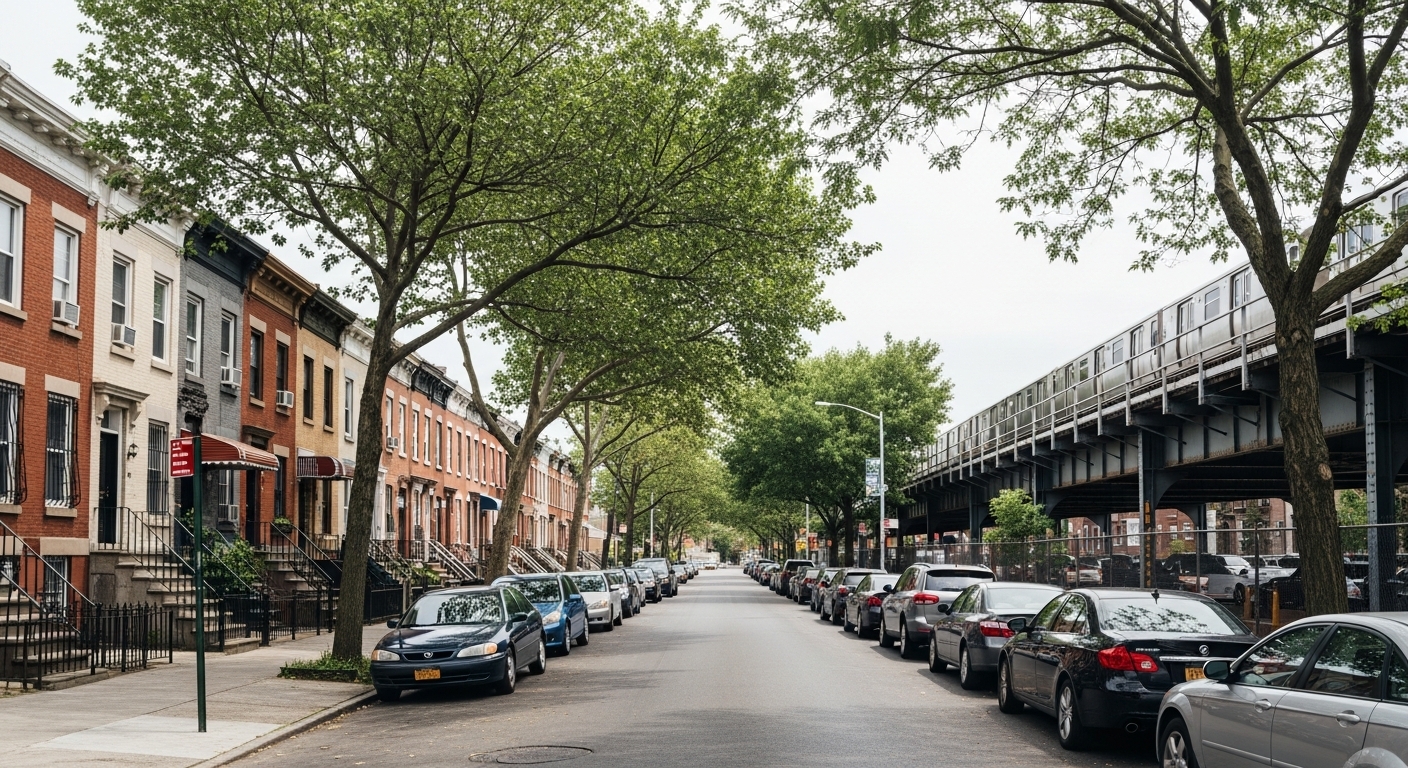
Brownsville is one of the most affordable neighborhoods in Brooklyn, and for buyers and investors who understand both its potential and its realities, that affordability is the entire story. Median home prices in Brownsville sit well below the Brooklyn average, the neighborhood is served by the 3 train and the L train, and its housing stock is a mix of two- and three-family homes, smaller rowhouses, and a high concentration of public housing. This guide is an honest look at Brownsville for people thinking about buying a home here or investing capital here in 2026 – what works, what to watch, and who the neighborhood actually fits.
I do not write neighborhood guides to sell a fantasy. Brownsville is a real place with real strengths and real challenges, and the buyers and investors who do well here are the ones who walked in with clear eyes. That is what this guide is for.
Where Brownsville Is and What It Borders
Brownsville sits in eastern Brooklyn. It is bordered by Crown Heights to the northwest, Ocean Hill to the north, East New York to the east, Canarsie to the south, and East Flatbush to the west. That location matters for one specific reason: every one of those bordering neighborhoods has seen significant price appreciation over the past decade. Brownsville sits in the geographic middle of a part of Brooklyn that has been steadily climbing, and it remains the most affordable point on that map.
The neighborhood’s main commercial spine runs along Pitkin Avenue and Belmont Avenue, with additional retail along Rockaway Avenue. These corridors carry the everyday shopping, food, and services for the neighborhood.
Getting Around: Transit in Brownsville
Brownsville is served primarily by the 3 train on the IRT New Lots Line, with elevated stations at Rockaway Avenue, Saratoga Avenue, Sutter Avenue-Rutland Road, and Junius Street. The L train also serves the neighborhood’s edge, and a free transfer between the 3 train at Junius Street and the L train at Livonia Avenue connects the two lines – currently a short outdoor walk between the two separate stations, with an accessibility-focused connector under construction to link them more directly.
For a buyer, the practical read is this: the 3 train provides a one-seat ride into Manhattan, but Brownsville is genuinely far out on the line. Commute times to Midtown and Lower Manhattan are long compared to neighborhoods deeper into Brooklyn. Anyone buying here should ride the commute at rush hour before they sign anything – the transit access is real, but the time cost is also real, and it should be priced into the decision honestly.
The Housing Stock
Brownsville’s housing breaks into a few clear categories, and understanding them is the key to understanding the buying and investing opportunity.
Public housing. Brownsville has one of the highest concentrations of public housing in New York City. A large share of the neighborhood’s residents live in developments operated by the New York City Housing Authority. This is a defining feature of the neighborhood and it shapes everything from the streetscape to the buyer pool. It is not a detail to gloss over – it is central to understanding the area.
Two- and three-family homes. The privately owned housing stock in Brownsville is heavily weighted toward small multi-family buildings – two- and three-family homes that an owner can live in while renting the other units. For an owner-occupant buyer, this is the most important category in the neighborhood, because it is the structure that makes a Brownsville purchase financially work for many people.
Rowhouses and smaller single-family homes. There is a stock of older rowhouses and smaller homes scattered through the neighborhood, generally at lower price points and frequently in need of renovation.
Brownsville for Homebuyers
For an owner-occupant, the Brownsville case rests on one structure: the small multi-family home.
Buying a two- or three-family house and living in one unit while renting the others – what buyers call house hacking – is the strategy that makes Brownsville’s affordability genuinely powerful. The rental income from the additional units offsets a meaningful portion of the mortgage, which can put homeownership within reach for a buyer who would be priced entirely out of Crown Heights or Bed-Stuy. An owner-occupant of a small multi-family can also use FHA financing with a low down payment, which lowers the cash barrier to entry further.
The honest counterweight: becoming a landlord is a real job, not passive income. Managing tenants, maintenance, and the responsibilities of owning a multi-family building is work, and a first-time buyer should go in understanding that they are buying a small business along with a home. New York City’s tenant protection laws are among the strongest in the country, and any buyer of an occupied multi-family building must understand the rent-regulation and tenancy status of every existing unit before closing. This is not optional due diligence – it is the single most important thing to verify, and it is worth paying an experienced attorney to confirm.
Brownsville for Investors
For investors, Brownsville is fundamentally a cash-flow and long-horizon appreciation play, not a quick-flip market.
The cash-flow case is straightforward: low acquisition prices relative to achievable rents can produce rental yields that are difficult to find in more expensive Brooklyn neighborhoods. The appreciation case is geographic: Brownsville is surrounded by neighborhoods that have already appreciated significantly, and the long-term thesis is that the most affordable point on that map has a runway.
The honest counterweights for investors are just as important:
Tenant law. New York City and New York State tenant protections are extensive and strongly favor tenants. Eviction is slow and difficult. Investors who underwrite deals on the assumption of easy turnover are underwriting them wrong.
Rent regulation. Many older multi-family buildings contain rent-stabilized units. A stabilized unit caps what an owner can charge and what increases are permitted. Every deal requires verifying the regulatory status of every unit, because that status determines the actual income the building can produce.
Renovation costs. Construction and renovation in New York City are expensive, and older Brownsville buildings often need significant work. An investor must underwrite realistic renovation budgets, not optimistic ones.
It is a long hold. Brownsville rewards patience. Investors looking for a fast return are in the wrong neighborhood. Investors with a multi-year, multi-cycle horizon are in the right one.
Who Brownsville Fits
Brownsville is the right neighborhood for an owner-occupant buyer who wants to own in Brooklyn, is priced out of the pricier neighborhoods, and is genuinely prepared to buy a small multi-family home and take on the work of being a landlord. It is the right neighborhood for a patient investor focused on cash flow and a long appreciation horizon who understands New York’s tenant and rent-regulation environment.
It is not the right fit for a buyer who needs a short commute, wants a move-in-ready single-family home, or wants passive ownership with no landlord responsibilities. And it is not the fit for an investor who needs a quick return.
How We Help
We work eastern Brooklyn directly, and Brownsville is a neighborhood where local knowledge is not a nice-to-have – it is the difference between a deal that works and one that does not. We help buyers and investors evaluate individual buildings, verify tenancy and rent-regulation status before they commit, and underwrite deals on realistic numbers rather than hopeful ones.
If you are weighing Brownsville for a home purchase or an investment, reach out. We will give you a straight, address-specific read on whether a particular building is worth pursuing.