

title: “Park Slope vs Prospect Heights — Brooklyn’s Brownstone Belt Compared”
client: ownapieceofbrooklyn
slug: park-slope-vs-prospect-heights-brooklyns-brownstone-belt
date: 2026-05-04
category: 4
status: published
Park Slope and Prospect Heights sit shoulder-to-shoulder on the western edge of Prospect Park, share much of the same housing stock, and from a passing glance can feel like one continuous brownstone neighborhood. They are not. The character, the price points, the buyer profiles, and the reasons people commit to one over the other are genuinely different — and the difference matters when you’re putting seven figures into a Brooklyn townhouse or co-op.
This guide walks through the practical comparison, drawing on what we see day-to-day from buyers and sellers across the brownstone belt. If you’re trying to decide which neighborhood fits how you actually want to live, this is the comparison that matters.
The shared geography
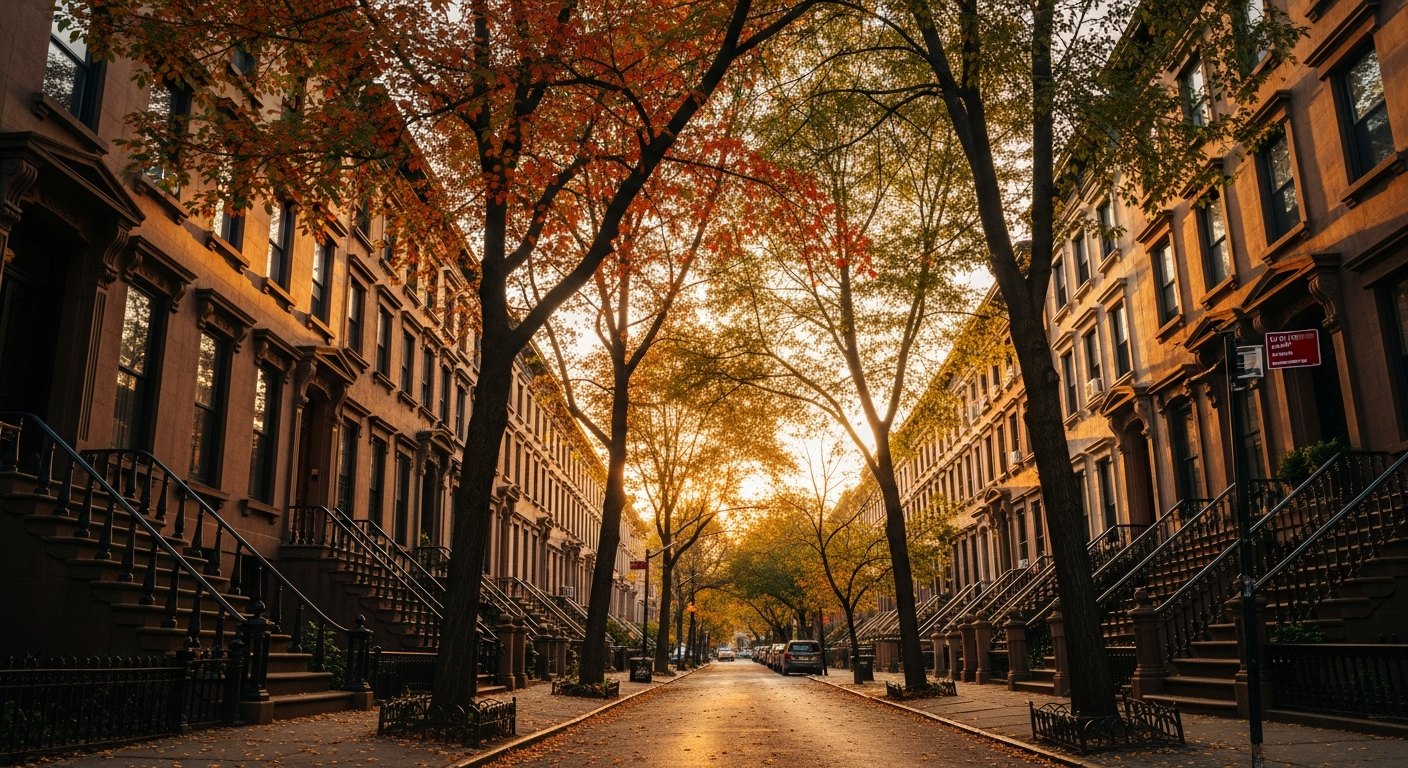
Both neighborhoods front Prospect Park. Both are anchored by classic 19th-century brownstone and limestone rowhouses, with a layer of pre-war and early-20th-century apartment buildings filling in the side streets. Both have working subway access, real Main-Street commercial strips, and a meaningful share of households who have lived in the neighborhood for 20+ years alongside a steady inflow of newer residents.
The boundary between the two is functionally Flatbush Avenue, with Prospect Heights to the east and Park Slope to the west. It’s a four-minute walk in some places, and yet the experience on either side feels distinct.
Park Slope — established, family-driven, premium-priced
Park Slope is the older brand. Its identity solidified in the 1990s and 2000s as Brooklyn’s flagship family neighborhood — strollers, public schools that families will move zip codes for, restaurants that cater to date night and Sunday brunch, and a housing stock dominated by single-family and two-to-four-family brownstones.
Key characteristics:
- Housing stock: Predominantly brownstone and limestone rowhouses on tree-lined streets, plus a layer of larger pre-war apartment buildings, especially closer to the park.
- School district: Park Slope falls primarily within District 15, with several highly sought-after elementary and middle schools. School zoning is one of the dominant pricing drivers in the neighborhood, and properties in the most-desirable zones command real premiums.
- Commercial strips: Seventh Avenue is the historic main drag. Fifth Avenue has become the more dynamic restaurant and bar corridor over the last decade.
- Subway access: Multiple options — F/G at 7th Avenue and 15th Street/Prospect Park, R at Union Street, B/Q at 7th Avenue, and 2/3 at Grand Army Plaza on the park’s north edge.
- Pricing (2026 reference): Townhouses in Park Slope’s prime blocks transact in a wide range, with single-family-converted brownstones in the $4M–$8M+ range depending on width, condition, and block. Larger or trophy-quality houses on premium blocks can move higher. Co-op and condo pricing in the neighborhood spans a similarly wide range, with two-bedrooms in the $1.1M–$2M range typical and prime-building three-bedrooms running $2.5M–$5M+.
The neighborhood’s identity is mature. Owners tend to be in for the long term — many of the families we work with bought 10–20 years ago and are now considering whether to upgrade in-place, downsize, or pass property to the next generation. The buyer pool that comes in fresh is heavily family-driven: New York professionals in their 30s and 40s with school-aged or about-to-be-school-aged children, often relocating from Manhattan or more central Brooklyn after the kid math changes.
Prospect Heights — younger, denser, more dynamic
Prospect Heights wears its character differently. It’s smaller, geographically denser, and has had a more aggressive transformation arc over the past 15 years — driven in part by the Atlantic Yards/Pacific Park development at its northwest edge, the expansion of the Brooklyn Museum and Brooklyn Botanic Garden cultural complex on its eastern edge, and the deepening of Vanderbilt and Washington Avenues as restaurant and bar destinations.
Key characteristics:
- Housing stock: Brownstones and limestone rowhouses similar to Park Slope’s, but in a smaller and more compact footprint, with a higher share of multifamily buildings and a meaningful new-construction layer in the corridors closest to Atlantic Avenue.
- School district: Also primarily District 13 and District 17 depending on zone, with several strong elementary options. The school-zoning premium exists but is less pronounced than in Park Slope’s most contested blocks.
- Commercial strips: Vanderbilt Avenue is the heart of the neighborhood — restaurants, cafes, bars, weekend brunch volume that rivals any block in Brooklyn. Washington Avenue is the longer-running second corridor and has its own dense restaurant scene.
- Subway access: 2/3 at Grand Army Plaza and Bergen Street, B/Q at 7th Avenue, and the Atlantic Avenue–Barclays Center hub at the neighborhood’s northern edge — one of the most-connected stations in Brooklyn, with B, D, N, Q, R, 2, 3, 4, 5, and the LIRR.
- Pricing (2026 reference): Townhouses in Prospect Heights generally trade slightly below Park Slope on a like-for-like basis, with single-family-converted brownstones often in the $3M–$6.5M range and condition-driven outliers higher. Co-op and condo pricing has compressed the gap meaningfully — premier-building two-bedrooms run $1.1M–$1.9M, with three-bedrooms in the $2M–$4M range.
The neighborhood’s identity is younger and more dynamic. Buyers tend to be a mix of mid-career professionals who want a real Brooklyn neighborhood without the strict family-zoning premium, plus a steady share of families who chose Prospect Heights specifically because it offers most of what Park Slope offers at a discount. The density of the restaurant scene and the proximity to the Barclays Center transit hub also draw a meaningful share of buyers whose commute and social life live east toward downtown Brooklyn and Manhattan rather than west into Park Slope’s more residential interior.
Side-by-side comparison
| | Park Slope | Prospect Heights |
|—|—|—|
| Identity | Established family-driven brownstone neighborhood | Younger, denser, more dynamic restaurant scene |
| Housing stock | Mostly single- and 2–4-family brownstones, larger pre-war apartments | Brownstones plus more multifamily and new-construction layers |
| School zoning premium | Significant, especially in PS 321 / PS 39 / PS 107 zones | Real but less pronounced |
| Commercial heart | Seventh Avenue (historic), Fifth Avenue (dining) | Vanderbilt Avenue, Washington Avenue |
| Subway | F/G, R, 2/3, B/Q | 2/3, B/Q, plus the Atlantic-Barclays hub |
| Townhouse pricing (2026) | $4M–$8M+ for prime blocks | $3M–$6.5M typical, with outliers higher |
| Two-bedroom co-op/condo (2026) | $1.1M–$2M | $1.1M–$1.9M |
| Park access | West side of Prospect Park | North/east side of Prospect Park |
| Buyer profile | Families, long-term holders, school-zone buyers | Mid-career professionals, families seeking value, dining-driven buyers |
| Cultural anchors | Park Slope Food Coop, Old Stone House, BAM proximity | Brooklyn Museum, Brooklyn Botanic Garden, Barclays Center |
How buyers should think about choosing
A few decision frames that work in real conversations with buyers:
1. School-zoning is the highest-leverage factor for families. If you’re buying with a child in mind, the District 15 zoning in the heart of Park Slope is genuinely worth the premium for many families — but only if you map your specific likely school zone before you fall in love with a house. Properties on adjacent blocks can fall into very different school catchments.
2. Restaurant and walkability density tilts toward Prospect Heights. Vanderbilt and Washington Avenues have a denser, more dynamic dining scene per block than Park Slope’s commercial strips. If “good food walkable from my front door” is in your top three buying criteria, Prospect Heights makes a strong case.
3. Long-term hold value is excellent in both — slightly different curves. Park Slope’s appreciation has been steady and slow; Prospect Heights’s has been more uneven but has compressed the historical gap with Park Slope meaningfully over the last decade. Both neighborhoods are blue-chip Brooklyn for a 10-to-30-year hold.
4. Layout matters more than the neighborhood you settle on. Buyers regularly fall in love with one neighborhood and then end up choosing the other because the right house — the right width, the right floor plan, the right yard situation, the right level of restoration — appears across the boundary. Be open to the possibility that the house picks the neighborhood as much as the neighborhood picks the house.
5. Subway access is excellent in both, but profile matters. The Atlantic-Barclays hub gives Prospect Heights residents an easier reach into multiple Manhattan corridors and into downtown Brooklyn. Park Slope’s deeper interior favors residents whose lives orient west and south within Brooklyn.
Common mistakes we see brownstone-belt buyers make
- Overvaluing block-by-block aesthetics, undervaluing layout. A picture-perfect brownstone with a flawed floor plan you can’t easily fix is a worse buy than a less-photogenic house that lives well day-to-day. Spend less time on the front facade and more time on the kitchen, the staircase, the parlor floor, and the rear yard.
- Skipping mechanical and structural diligence. These houses are 100–150 years old. Foundations move. Roofs leak. Old plumbing has been spliced and re-spliced. Use an inspector who specializes in Brooklyn brownstones, not a generic NYC home inspector.
- Trusting the listing agent’s school-zone claim. Verify the exact zone with NYC DOE or your buyer’s agent. School zones can change, and properties have been mis-marketed.
- Assuming Park Slope is universally more expensive. It often is, but on a like-for-like comparison the gap is narrower than buyers expect, especially in apartment buildings of similar vintage.
- Buying without testing the neighborhood at multiple times of week. A weekday morning and a Saturday night feel different. Walk both before you commit.
Frequently Asked Questions
Is Park Slope or Prospect Heights better for families?
Both work well for families. Park Slope has the most established family infrastructure and the highest-demand public-school zoning in District 15. Prospect Heights has strong elementary options and a meaningful family share, often at a more accessible price point. The right answer depends on your specific school strategy and the price range that fits your budget.
Which neighborhood appreciates faster?
Both have appreciated steadily over the long term. Prospect Heights has compressed the gap with Park Slope meaningfully over the past 10–15 years, which means recent buyers in Prospect Heights have generally seen stronger percentage appreciation than recent buyers in already-premium Park Slope. Both remain blue-chip for long-term holds.
Are the brownstones really comparable across the two neighborhoods?
Yes — they’re substantially the same housing stock, built in a similar period, often by the same generation of developers. Lot widths, ceiling heights, parlor-floor layouts, and architectural detailing are highly comparable across the boundary. The neighborhoods diverge more on commercial character, density, and demographic profile than on the houses themselves.
Which neighborhood is closer to Prospect Park?
Both front the park directly. Park Slope sits along the western edge; Prospect Heights sits along the northern and northeastern edges. Most blocks in either neighborhood are 5–15 minutes’ walk from a park entrance.
Should I buy a townhouse or a co-op/condo?
That’s a separate decision and depends heavily on how you want to live. Townhouses give you control, outdoor space, and often more space per dollar at certain price points — at the cost of full responsibility for maintenance, mechanicals, and decisions like roof replacements. Co-ops and condos trade some control for lower-friction ownership and access to amenities. The right answer is buyer-specific.
How does Maxine McClinton at Own a Piece of Brooklyn help me decide?
We’ve worked the brownstone belt for years and can walk you through the trade-offs in detail before you start touring. The most useful thing we do for first-time brownstone buyers is map their specific buying criteria — budget, school zoning, layout needs, hold horizon — to the right neighborhood and the right block before they fall in love with one specific house. That conversation usually saves several months of frustrating tours.
Talk to Own a Piece of Brooklyn
Own a Piece of Brooklyn — Maxine McClinton’s brokerage at 389 Atlantic Avenue — represents buyers and sellers across Brooklyn’s brownstone belt and beyond. If you’re weighing Park Slope vs. Prospect Heights, or comparing them to the broader Brooklyn market, we’d be glad to walk you through the current inventory, the specific blocks that fit your criteria, and the real trade-offs no one in marketing copy is going to mention.
Contact Own a Piece of Brooklyn to schedule a brownstone-belt buyer briefing.