
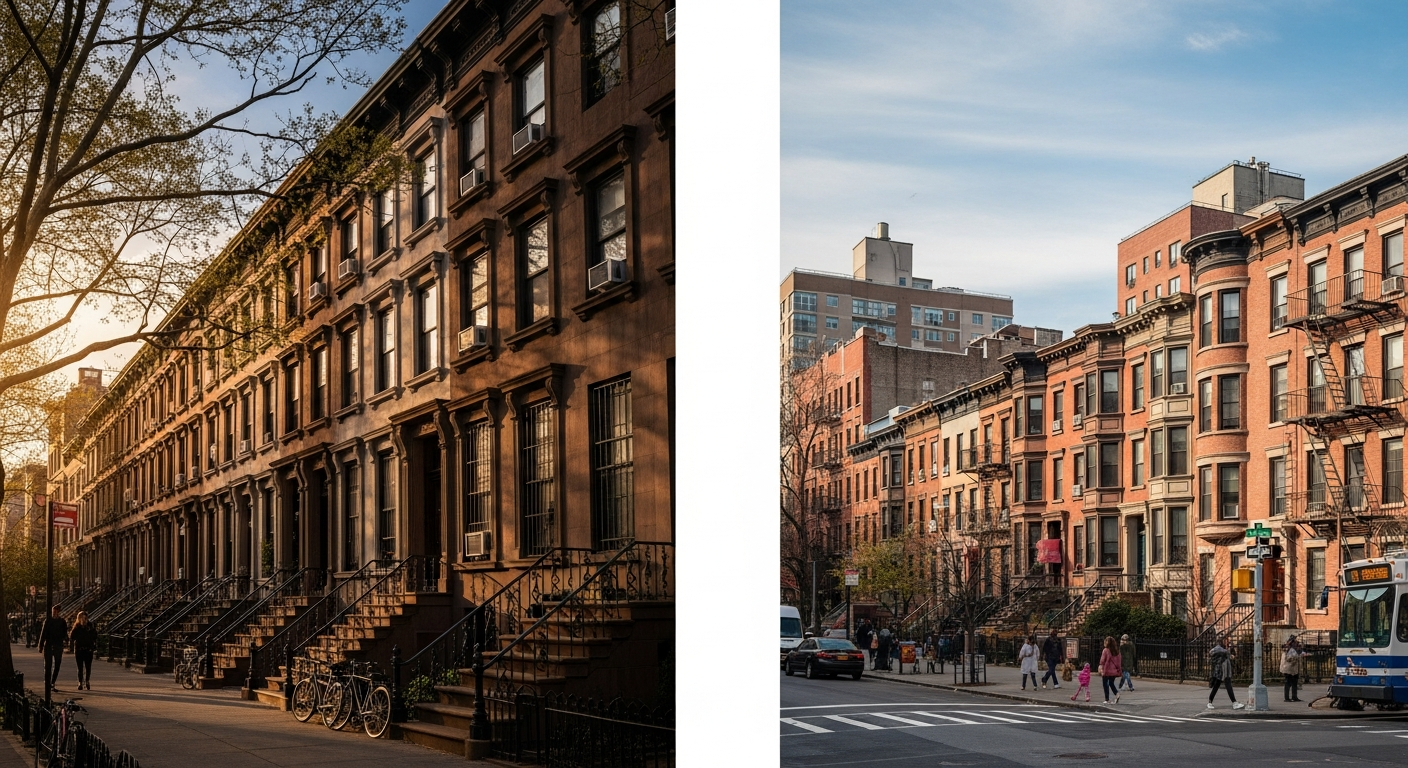

Brooklyn homebuyers face no shortage of compelling neighborhoods, but two names keep surfacing in every serious conversation: Bedford-Stuyvesant and Crown Heights. Both sit in the heart of Brooklyn, both offer stunning historic architecture, and both have experienced remarkable transformation over the past decade. Yet they deliver distinctly different living experiences, price points, and long-term investment profiles. This Bed-Stuy vs Crown Heights comparison breaks down everything you need to know before making one of the biggest financial decisions of your life.
Bedford-Stuyvesant: History, Architecture, and Cultural Identity
Bedford-Stuyvesant, universally known as Bed-Stuy, is the largest neighborhood in Brooklyn by area and one of the most historically significant communities in New York City. Established as a hub of Black culture and entrepreneurship in the early twentieth century, Bed-Stuy became the center of Brooklyn’s civil rights movement, produced legendary figures in music and the arts, and continues to carry that cultural weight today.
The Brownstone Capital of Brooklyn
What draws most buyers to Bed-Stuy is the architecture. The neighborhood contains one of the largest collections of intact Victorian brownstones in the country. Block after block of three- and four-story rowhouses line tree-shaded streets, many within designated historic districts that protect the neighborhood’s character. Stuyvesant Heights and Bedford-Stuyvesant/Expanded Stuyvesant Heights are among the landmark districts that ensure new development respects the existing fabric.
For buyers, the brownstone stock presents a range of options: unrenovated shells for those willing to take on a gut renovation, partially updated townhouses with original detail, and fully restored single- or multi-family homes commanding premium prices. That variety is a major reason buying in Bed-Stuy appeals to first-time purchasers, growing families, and seasoned investors alike.
Community and Culture
Bed-Stuy retains a strong sense of neighborhood identity. The annual Bed-Stuy Alive festival, community gardens along Herkimer Street, and a growing roster of Black-owned businesses along Fulton Street and Tompkins Avenue give the area a texture that newer Brooklyn neighborhoods simply cannot replicate. The Do the Right Thing mural at Stuyvesant and Lexington remains a cultural landmark, and local institutions like the Billie Holiday Theatre anchor the arts scene.
Crown Heights: Diversity, Prospect Park, and Creative Energy
Crown Heights sits directly south of Bed-Stuy and shares a border along Atlantic Avenue. While the two neighborhoods are often mentioned in the same breath, Crown Heights has its own powerful identity shaped by Caribbean immigration, the Hasidic Jewish community of Crown Heights South, and a growing influx of artists and young professionals.
Proximity to Brooklyn’s Best Green Space
The single biggest lifestyle differentiator for Crown Heights is Prospect Park. The western and southern edges of the neighborhood put residents within a short walk of 526 acres of Frederick Law Olmsted-designed parkland, plus the Brooklyn Museum, Brooklyn Botanic Garden, and the Brooklyn Children’s Museum. If weekend access to world-class cultural institutions and green space matters to you, buying in Crown Heights delivers that advantage in a way Bed-Stuy cannot match.
Caribbean Heritage and the Arts
Crown Heights is home to the annual West Indian American Day Carnival along Eastern Parkway, one of the largest parades in North America. That Caribbean influence shows up in the food, the music, and the community fabric year-round. Alongside this heritage, Franklin Avenue has emerged as a thriving commercial corridor with independent galleries, coffee shops, natural wine bars, and boutiques that give Crown Heights an increasingly creative-class identity.
Home Prices: What You Can Expect to Pay
Price is where the Brooklyn neighborhood comparison gets concrete. Both neighborhoods have appreciated significantly, but they sit at different price bands as of early 2026.
Bed-Stuy Pricing
| Property Type | Approximate Price Range |
|—|—|
| Brownstone shell (needs gut renovation) | $1.0M – $1.3M |
| Renovated two-family brownstone | $1.8M – $2.2M |
| Fully restored four-story townhouse | $2.3M – $2.8M |
| Condo (one-bedroom) | $550K – $750K |
| Condo (two-bedroom) | $850K – $1.1M |
| Multi-family (2-4 units) | $1.3M – $2.0M |
The median sale price across all Bed-Stuy property types reached approximately $1.6M in early 2026, reflecting strong year-over-year gains. Brownstone inventory is the primary driver; the limited condo stock keeps that segment relatively affordable compared to neighborhoods like Park Slope or Cobble Hill.
Crown Heights Pricing
| Property Type | Approximate Price Range |
|—|—|
| Townhouse / brownstone | $1.2M – $1.6M |
| Fully renovated limestone or brownstone | $1.6M – $2.2M |
| Condo (one-bedroom) | $500K – $700K |
| Condo (two-bedroom) | $750K – $1.0M |
| Multi-family (2-4 units) | $1.1M – $1.8M |
Crown Heights median home values are trending toward $1.25M to $1.35M overall, with townhouse prices pushing toward the $1.45M mark by late 2026. The condo market has been particularly active, with median condo prices around $886K and strong year-over-year appreciation. Crown Heights generally offers a lower entry point than Bed-Stuy for equivalent square footage, though the gap has been narrowing.
Transportation: Subway Access and Manhattan Commute Times
Both neighborhoods offer multiple subway options, but the experience differs depending on where in each neighborhood you land.
Bed-Stuy Transit
Bed-Stuy is served by six subway lines: the A, C, G, J, M, and Z. The A/C lines run along Fulton Street and connect to Lower Manhattan (Fulton Street station) in roughly 25 to 30 minutes and Midtown (Penn Station via transfer) in about 40 minutes. The J/M/Z elevated line runs along Broadway at the neighborhood’s northern edge, delivering a direct shot to the Financial District in under 30 minutes. The G train provides crosstown Brooklyn service without requiring a Manhattan transfer.
The western portion of Bed-Stuy near Nostrand Avenue enjoys the best transit access. Buyers in eastern Bed-Stuy, closer to Broadway Junction, should factor in longer walks to stations or reliance on the J/Z.
Crown Heights Transit
Crown Heights is served by the 2, 3, 4, and 5 lines along Eastern Parkway and the S (Franklin Avenue Shuttle) connecting to the B/Q at Prospect Park. The 2/3 express trains reach Midtown Manhattan (Times Square) in approximately 30 to 35 minutes and Wall Street in about 25 minutes. The 4/5 lines, accessible at Franklin Avenue and Nostrand Avenue stations, provide additional express service.
Crown Heights arguably has the edge in transit speed for Midtown-bound commuters thanks to express service on the 2/3/4/5. Bed-Stuy offers more route options but relies more heavily on local service.
Schools: Options for Families
Both neighborhoods are served by NYC Department of Education District 16 (Bed-Stuy) and District 17 (Crown Heights), and both benefit from the city’s school choice system that allows families to apply across district boundaries.
Bed-Stuy Schools
Bed-Stuy has 46 public schools serving nearly 16,000 students. Standouts include Bedford Academy High School, a selective public school with consistently strong graduation rates, and several Success Academy charter campuses (Bed-Stuy 1, 2, and 3) that post among the highest test scores citywide. Average math proficiency in Bed-Stuy schools sits at 58 percent, and reading proficiency at 68 percent, both above statewide averages.
Crown Heights Schools
Crown Heights families have access to well-regarded options including P.S. 705 the Brooklyn Arts and Science Elementary School, Brooklyn Prospect Charter School, and the Crown Heights campus of Achievement First. The neighborhood also benefits from proximity to selective middle and high schools in neighboring Prospect Heights and Fort Greene.
Both neighborhoods have a mix of zoned, charter, and magnet school options. Families buying in either area should research specific school zones at the block level, as quality can vary significantly over short distances.
Food, Shopping, and Nightlife
Bed-Stuy Dining and Nightlife
Bed-Stuy’s food scene has exploded in recent years while retaining long-standing neighborhood institutions. Peaches on Lewis Avenue remains a brunch destination, Saraghina serves some of Brooklyn’s best pizza, and Lover Boy has become a cocktail bar fixture. Fulton Street and Tompkins Avenue are the primary commercial strips, with a growing number of Black-owned restaurants, bakeries, and specialty shops. For nightlife, the scene leans toward intimate cocktail bars and live music venues rather than large-scale clubs.
Crown Heights Dining and Nightlife
Franklin Avenue is the culinary heart of Crown Heights. Glady’s serves Caribbean-inspired dishes that nod to the neighborhood’s heritage, Chavela’s draws crowds for Mexican food and mezcal, and Berg’n, a beer hall in a repurposed warehouse, anchors a stretch of Dean Street that has become a weekend gathering spot. The Caribbean food on Nostrand Avenue, from roti shops to jerk chicken counters, remains some of the most authentic in the city. Crown Heights nightlife tilts slightly younger and louder than Bed-Stuy, with rooftop bars and DJ-driven weekend events becoming more common.
Shopping
Neither neighborhood is a major retail destination, but both have strong local commercial corridors. Bed-Stuy’s Fulton Street offers a mix of boutiques, vintage shops, and everyday services. Crown Heights’ Franklin Avenue has leaned more upscale in recent years with curated home goods stores, independent bookshops, and specialty grocers alongside the long-standing neighborhood businesses.
Investment Potential: Appreciation and Rental Yields
For buyers evaluating these neighborhoods as investments, both present compelling but different cases.
Bed-Stuy Investment Profile
Bed-Stuy is widely considered one of the strongest long-term investment plays in Brooklyn. Real estate analysts point to its architectural pedigree, historic district protections, and proven track record of appreciation. Brownstone townhouses have been the primary wealth-building vehicle, with fully renovated two-family homes generating rental income from a garden or parlor floor apartment while the owner occupies the upper floors.
Average rents in Bed-Stuy sit around $3,030 per month, approximately 28 percent below the overall Brooklyn average, which provides room for continued rent growth. Investors looking at a seven- to ten-year horizon frequently cite Bed-Stuy as the most balanced opportunity in brownstone Brooklyn, offering double-digit upside potential with manageable risk.
Crown Heights Investment Profile
Crown Heights has experienced faster percentage appreciation in recent years, partly because it started from a lower base. The condo market has been particularly strong, with year-over-year price increases exceeding 60 percent in some segments during 2025 and early 2026. Townhouse supply is tighter than in Bed-Stuy, and estate liquidations and off-market transfers increasingly drive the private home market, often triggering immediate multiple-offer scenarios.
Average rents in Crown Heights are approximately $3,340 per month. The neighborhood’s trajectory suggests continued upward pressure on both sale prices and rents, though buyers should be aware that some blocks remain more speculative than others, particularly in the eastern sections farther from Prospect Park.
Head-to-Head
| Factor | Bed-Stuy | Crown Heights |
|—|—|—|
| 5-year appreciation trend | Strong and steady | Faster, from lower base |
| Rental yield potential | Higher (lower entry cost for multi-family) | Moderate |
| Inventory availability | More townhouse stock | Tighter supply |
| Speculative risk | Lower | Moderate (block-dependent) |
Safety and Quality of Life
Both Bed-Stuy and Crown Heights have seen significant improvements in public safety over the past two decades, consistent with citywide trends. Crime rates in both neighborhoods have dropped substantially, though as with any urban area, there is block-by-block variation. Buyers should walk target blocks at different times of day and check NYPD precinct-level data for the most current picture.
Quality of life in Bed-Stuy centers on the residential streetscape: quiet, tree-lined blocks of brownstones create an almost suburban feel despite being minutes from Manhattan. Crown Heights offers a slightly more urban-energy lifestyle, with busier commercial corridors and the draw of Prospect Park for outdoor recreation, running, and weekend farmers markets.
Both neighborhoods have active community boards and civic organizations that advocate for residents on zoning, development, and quality-of-life issues.
Who Should Buy Where?
Bed-Stuy is ideal for buyers who:
- Prioritize architectural character and historic brownstone living
- Want more square footage and townhouse options for the money
- Are looking for multi-family investment properties with rental income
- Value a quieter, residential feel with strong neighborhood identity
- Have a longer investment horizon and want proven appreciation
Crown Heights is ideal for buyers who:
- Want proximity to Prospect Park, Brooklyn Museum, and Botanic Garden
- Prefer a walkable, restaurant-and-bar-heavy commercial corridor
- Are buying a condo and want the most competitive pricing in central Brooklyn
- Value express subway service for a faster Midtown commute
- Want to be in a neighborhood with strong near-term price momentum
Making Your Move in Brooklyn
Whether you lean toward the brownstone grandeur of Bed-Stuy or the park-adjacent energy of Crown Heights, the most important step is working with someone who knows these blocks intimately. Pricing, school zones, transit access, and investment potential can shift from one street to the next, and that granular knowledge is what separates a smart purchase from a costly mistake.
Maxine McClinton at Own a Piece of Brooklyn specializes in helping buyers navigate exactly this kind of decision. With deep roots in Brooklyn and a track record with Compass, Maxine can walk you through specific blocks, connect you with the right inspectors and attorneys, and help you build a strategy that fits your budget and goals. If you are comparing Bed-Stuy and Crown Heights, or exploring any Brooklyn neighborhood, reach out to Maxine at ownapieceofbrooklyn.com to start the conversation.
This guide reflects market conditions and neighborhood data as of early 2026. Real estate markets change quickly. Always verify current pricing, school assignments, and transit schedules with up-to-date sources before making a purchase decision.